

Finding affordable licensed mental health care involves more than locating the lowest advertised price. Check the provider’s qualifications, the full cost, eligibility and whether you can realistically continue. Insurance, community services, reduced fees and supervised training clinics may offer different routes.
Describe the help you need
You do not need a self-diagnosis to ask for an appointment. You can describe the concern and its effect: “Anxiety is affecting my sleep and work,” or “I need support after a difficult change.”
A primary care clinician may help you identify options. The NIMH guide to finding mental health help also describes insurance, community and other routes. Availability varies, so ask whether a service is accepting clients and whether there is a waiting list.
Check insurance with both the insurer and provider
If you have coverage, ask about the exact clinician and service rather than assuming a practice name is enough. Confirm:
- Whether the provider is in network for your plan.
- Your deductible, copayment or coinsurance.
- Referral, authorization or visit requirements.
- Coverage for telehealth and your location.
- What happens if a claim is not paid.
The provider and insurer may hold different parts of the information. Ask for clarification before relying on an estimate, and keep relevant confirmation details.
Ask directly about reduced fees
Some providers offer a sliding scale or a limited number of lower-fee appointments. Ask what is available, who qualifies, how long the arrangement lasts and whether the cost changes later.
Try: “My sustainable budget is around ___ per appointment. Do you have reduced-fee places, or can you suggest an appropriate service?” Naming a limit is useful information, not an apology.
Discuss frequency and treatment needs with the clinician rather than making a plan based only on price. Ask about alternatives if the recommended arrangement is unaffordable.
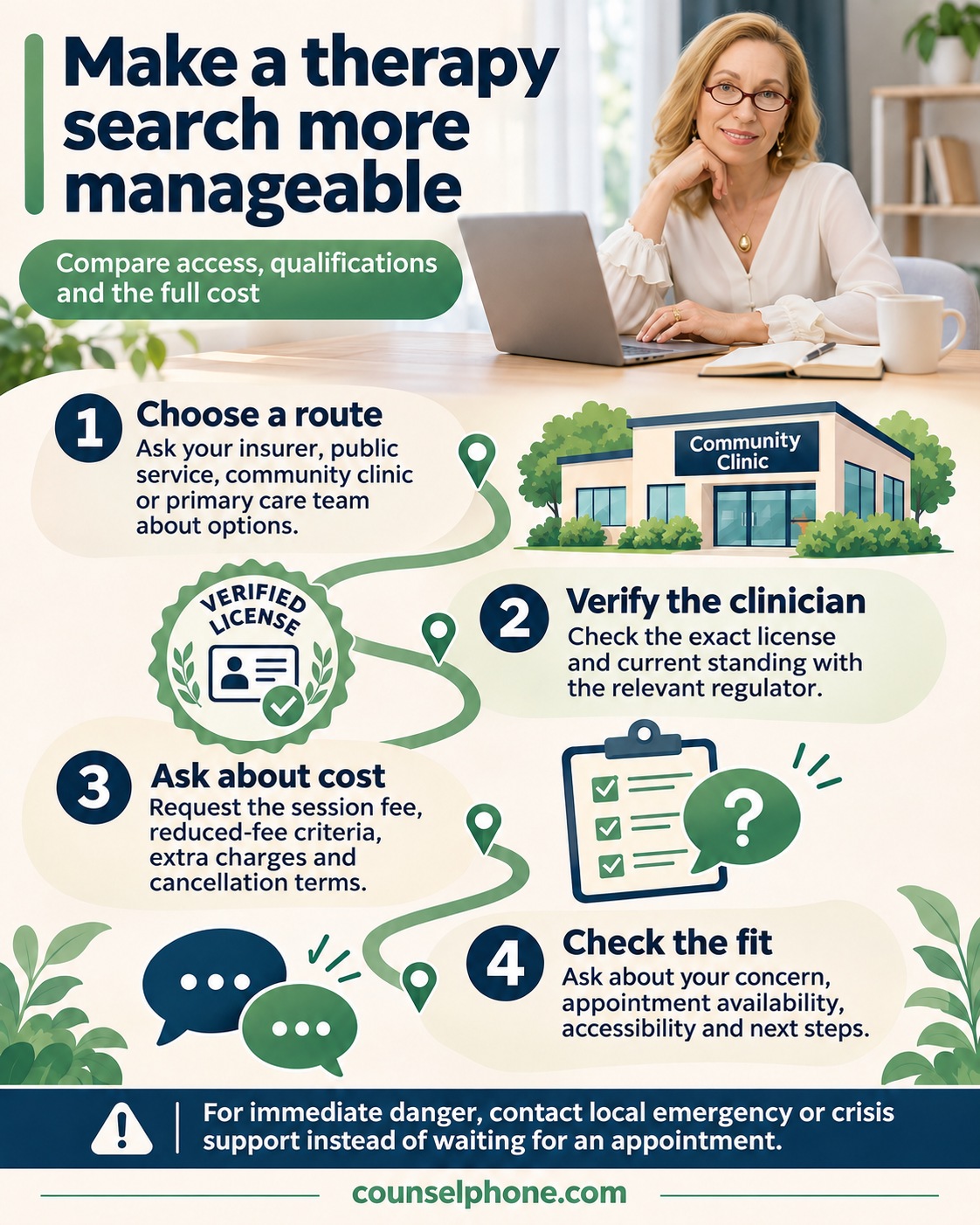
Read the visual guide as text
- Choose a route. Ask your insurer, public service, community clinic or primary care team about options.
- Verify the clinician. Check the exact license and current standing with the relevant regulator.
- Ask about cost. Request the session fee, reduced-fee criteria, extra charges and cancellation terms.
- Check the fit. Ask about your concern, appointment availability, accessibility and next steps.
For immediate danger, contact local emergency or crisis support instead of waiting for an appointment.
Explore community and training services
In the US, community health centers may provide or connect people with behavioral health care. HRSA’s eligibility information explains access and income-based fees at health centers. Check the particular center’s services and waiting times; not every location offers the same care.
University or professional training clinics may offer supervised services at reduced cost. Ask about the trainee’s role, the supervisor’s qualifications, consent, privacy, recording practices and continuity when placements change.
Employee assistance programs, public services or nonprofit clinics may also be relevant. Check the number of covered sessions and what happens when short-term support ends.
Verify the person and the total cost
Check the exact professional license with the relevant regulator where you live or receive care. For remote appointments, ask whether the clinician is authorized to treat you in your location.
Compare the likely ongoing cost, including cancellations, missed appointments, travel and required subscriptions. For an online plan, ask what contact is included, who provides it, response times, automatic renewal and how to cancel.
Coaching, peer support and spiritual readings may have a place in someone’s life, but they do not become licensed mental health treatment because they are more affordable or easier to book.
Use a short first inquiry
“I am looking for licensed help with ___. I live in ___. Are you accepting clients, what would the full fee be, and are reduced-cost options available?”
You do not need to send a full personal history in an initial message. Share necessary details through the service’s appropriate secure intake process. If the first service cannot help, ask for a suitable referral or an alternative to try while waiting.
Know where urgent support fits
A waiting list or routine appointment is not an emergency plan. In the US, call or text 988 for mental health crisis support. Call 911 for a life-threatening emergency. Elsewhere, use local crisis or emergency services.
Once you have an appointment, ask about fit, goals, practical access and how progress will be discussed. You can seek another provider if the arrangement is unsuitable. Start with one inquiry that gives you usable information about qualified care you can afford.