

A therapist, counselor, coach and psychic may all offer a conversation, but they do not offer the same service. Start with the help you need, then check what the particular person is qualified to provide. A warm manner matters; it does not establish a clinical qualification.
Name the kind of support you want
You might want treatment for persistent anxiety, help making a career plan, practical support with a relationship conversation, or a spiritual perspective. These needs can overlap, but the roles should stay clear.
Try completing this sentence: “I want help with ___, and I need someone who can ___.” If the concern involves symptoms, diagnosis, medication or mental health treatment, begin with an appropriately licensed health professional. The NIMH guide to finding help describes possible routes.
What the title therapist tells you
“Therapist” is a broad word. In mental health settings, licensed professionals may provide psychotherapy within their scope of practice. The exact professional title, training and legal requirements vary by location.
Ask for the person’s full credential, license number and licensing jurisdiction. Check the relevant regulator’s public register. A directory listing or an impressive certificate is not a substitute for that check. A trainee may work under supervision; ask who supervises the work and how concerns are handled.
The NIMH psychotherapy overview explains what treatment can involve and questions to ask a prospective provider.
Why counselor can mean different things
A licensed mental health counselor may provide psychotherapy within their license and professional scope. The word counselor is also used in school, pastoral, career and other settings. The title alone does not tell you whether someone can diagnose or treat a mental health condition.
Rather than deciding that a counselor is always less qualified than a therapist, compare the actual credentials and service. Ask what concerns they work with, whether their approach fits your needs, and when they refer someone elsewhere.
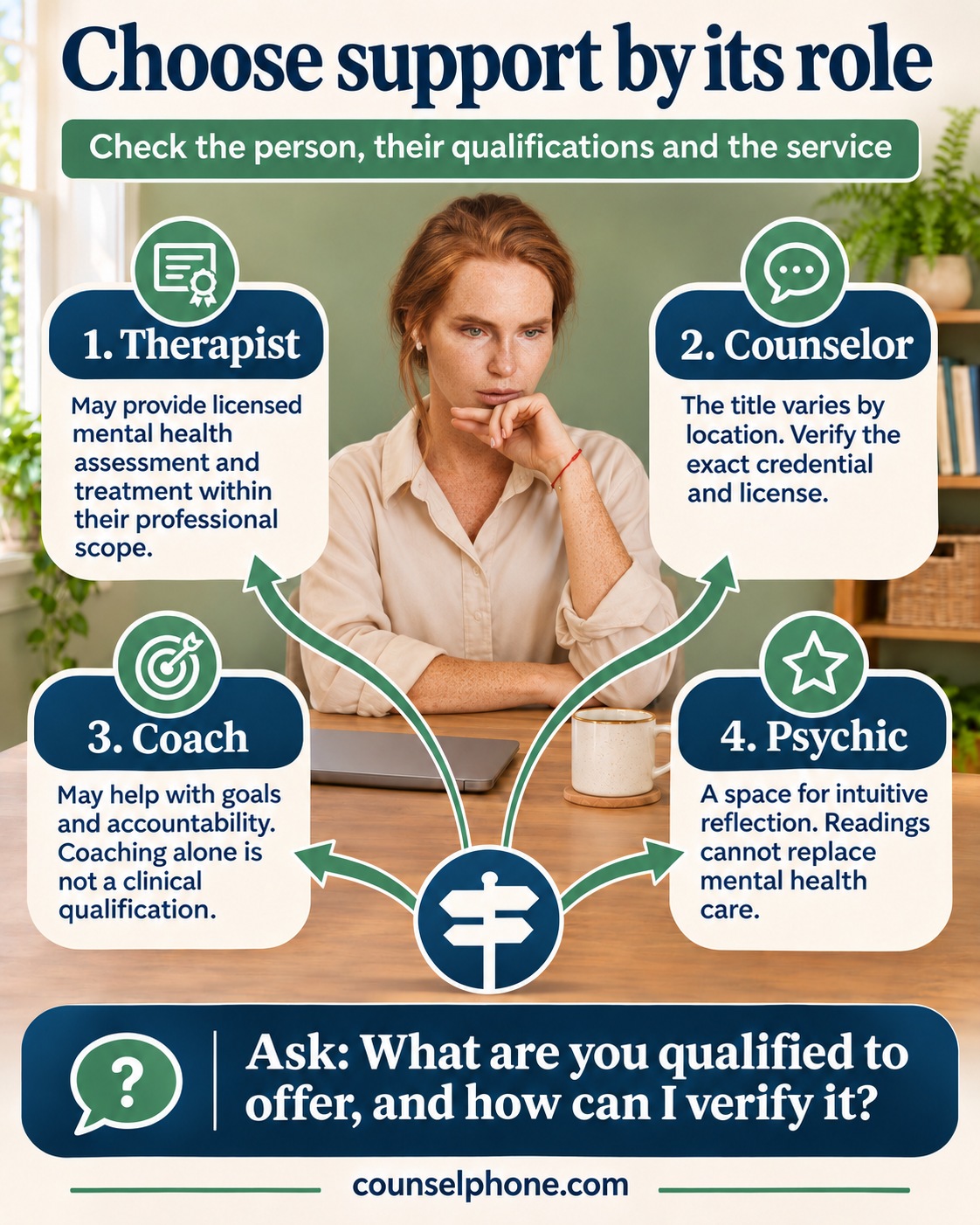
Read the visual guide as text
- Therapist. May provide licensed mental health assessment and treatment within their professional scope.
- Counselor. The title varies by location. Verify the exact credential and license.
- Coach. May help with goals and accountability. Coaching alone is not a clinical qualification.
- Psychic. A space for intuitive reflection. Readings cannot replace mental health care.
Ask: What are you qualified to offer, and how can I verify it?
What coaching can offer
Coaching commonly focuses on goals, decisions, habits and accountability. You might use it to organize a work transition or follow through on a project. A coaching credential alone is not a mental health license.
A responsible coach explains the service’s limits. If symptoms or distress require clinical care, coaching should not be presented as a replacement. The International Coaching Federation’s referral guidance discusses the distinction between coaching and therapy.
What to expect from a psychic reading
A psychic reading may offer spiritual or intuitive perspectives through conversation, cards or another practice. For someone who values that tradition, it can provide questions to reflect on. It is not a clinical assessment, diagnosis or treatment.
Before booking, ask about the format, total cost, length, privacy and subjects the reader will not address. You remain free to disagree with an interpretation or end the session. Claims that you must stop treatment, pay urgently to remove a threat, or surrender control of a personal decision are reasons to step back.
A person can hold more than one qualification. If a licensed clinician also offers spiritual services, clarify which role applies to this appointment and what professional protections accompany it.
Check privacy, costs and practical arrangements
- Qualifications: What credential applies to this service, and where can I verify it?
- Scope: What help can you provide, and what is outside your role?
- Privacy: What is recorded or stored, who can access it, and what are the limits of confidentiality?
- Fees: What is the full charge, cancellation policy and likely ongoing cost?
- Concerns: How can I raise a problem, change providers or obtain a referral?
Confidentiality is not identical across every service. Licensed care has rules and exceptions that should be explained. Online platforms may also have their own data policies.

Send a short first inquiry
You do not need to send your full personal history to ask whether a service fits. For example: “I am looking for help with anxiety that is affecting work. Are you licensed to provide treatment where I live? Are you accepting clients, and what are the fees?”
If you booked the wrong kind of support, you can change direction. Ask for a clearer explanation or an appropriate referral. Choosing a service is a practical decision you may revisit as your needs change.
For immediate danger or a life-threatening emergency, use emergency services. In the US, call or text 988 for mental health crisis support; a routine reading or coaching appointment is not an emergency response service.