

When you are exhausted, a task can matter to you and still feel beyond reach. Wanting a clean home, a finished application or time with someone you love does not give you unlimited energy. A stronger reason to keep going is not always what you need.
Start by asking what would make today more manageable: rest, help, a smaller task or attention to your health. You can care about a goal while changing the pace, asking for an adjustment or deciding that something can wait.
On this page
Take exhaustion seriously
Notice the difficulty before naming it a motivation problem. Are you struggling to begin something you dislike, or do ordinary activities feel unusually tiring? Have sleep, illness, caring responsibilities, work demands or a medication change become relevant? These questions can help you describe the situation; they cannot diagnose its cause.
The NHS guidance on tiredness and fatigue recommends medical advice when tiredness lasts a few weeks without a clear reason, affects daily life or comes with other symptoms. You do not need to finish a self-improvement routine before asking for that help. Avoid changing prescribed treatment on your own.
For an appointment, you could note when the tiredness began, what daily activities have become difficult and any changes you have noticed. Persistent exhaustion deserves attention even when you have meaningful goals and people depending on you.

Choose what matters today
Separate the immediate need from the whole ambition. “I want a different job” is a direction. “I need to check whether this application closes today” is a decision you can make now. Once you know the deadline, you can choose whether to take a small step, request help or leave it.
Try sorting the demands in front of you into three groups:
- Needs attention today: an essential responsibility, basic care or something with a genuine deadline.
- Can change: a task whose size, timing or standard you can negotiate.
- Can wait: an optional commitment that does not need your limited energy now.
Choose a manageable priority rather than writing a longer list to prove you are trying. If several essential responsibilities conflict, the next step may be a conversation about support. Planning cannot create time, money or care that is unavailable.
Make the starting point smaller
Define an action with a clear end. Instead of “sort out all my paperwork,” try “find the letter with the appointment time.” Instead of “clean the kitchen,” choose “put the food that needs refrigerating away.” You can stop after the useful part you selected.
Ask what makes starting difficult. An unclear instruction may need a question; a missing document may need a search; a physically demanding job may need assistance or a different method. Treat the obstacle as information about the task.
A timer is optional. If watching the clock adds pressure, use a natural stopping point, such as reading one paragraph or sending one necessary reply. Check how you feel before adding another task. A small start is a choice, not a promise that you will suddenly want to do everything.
Reduce demands and ask for specific help
Think about what another person could realistically take on. “Could you collect the prescription?” or “Can we move this call to Thursday?” gives them a concrete request. At work or in education, you might ask about priorities, an extension or an appropriate adjustment.
Where it is safe, explain your capacity without turning it into a debate about your character: “I can complete the urgent section today. I need more time for the rest.” Another person may not agree, but their response does not establish whether your exhaustion is real.
Look at patterns as well as individual requests. Repeated last-minute demands, interrupted rest or an unfair share of care may need an ongoing change. You do not have to label someone a negative person to recognise that a particular arrangement is not working.
Choose activity that fits your health and energy
Food, rest and a comfortable environment may need attention before another attempt at productivity. Use the options you can access and manage. A simple meal or help with a household task can be a sensible choice.
If movement feels suitable, choose something comfortable and consistent with your health guidance. It could be changing position or an activity you already enjoy. Exercise is not a first step everyone must take when exhausted, and pushing through symptoms is not a test of commitment.
If exertion makes you feel worse, stop and seek appropriate advice rather than increasing it to force motivation. Follow any existing guidance for a health condition. Music, dancing and energising routines are optional interests, not a reliable way to override the need for care.
Use a pause to decide what comes next
A pause might mean sitting comfortably, looking away from a screen or putting off a nonessential decision. If meditation, prayer or a quiet reflection matters to you, you can include it. Keep your eyes open if you prefer, and stop an exercise that makes you uncomfortable. There is no required mental state to achieve.
Afterwards, ask: “What is the most useful next choice at my current capacity?” It could be a small action, a request for help, more rest or arranging an appointment. You do not have to feel inspired before making that choice.
If low mood, loss of interest or other distress is also affecting daily life, consider talking with a qualified professional. The NIMH guide to caring for your mental health describes everyday care and when to seek support. Motivation techniques need not carry the whole burden of recovery.
When a chore feels too big to begin
If a pile of paperwork feels impossible, choose one document to open and identify the next action. You can stop when that is done or ask another person to sit with you while you begin.
Notice whether difficulties follow a specific workload or continue despite rest. If fatigue persists, changes suddenly or affects everyday tasks, ask a healthcare professional for advice.
Read the infographic in text
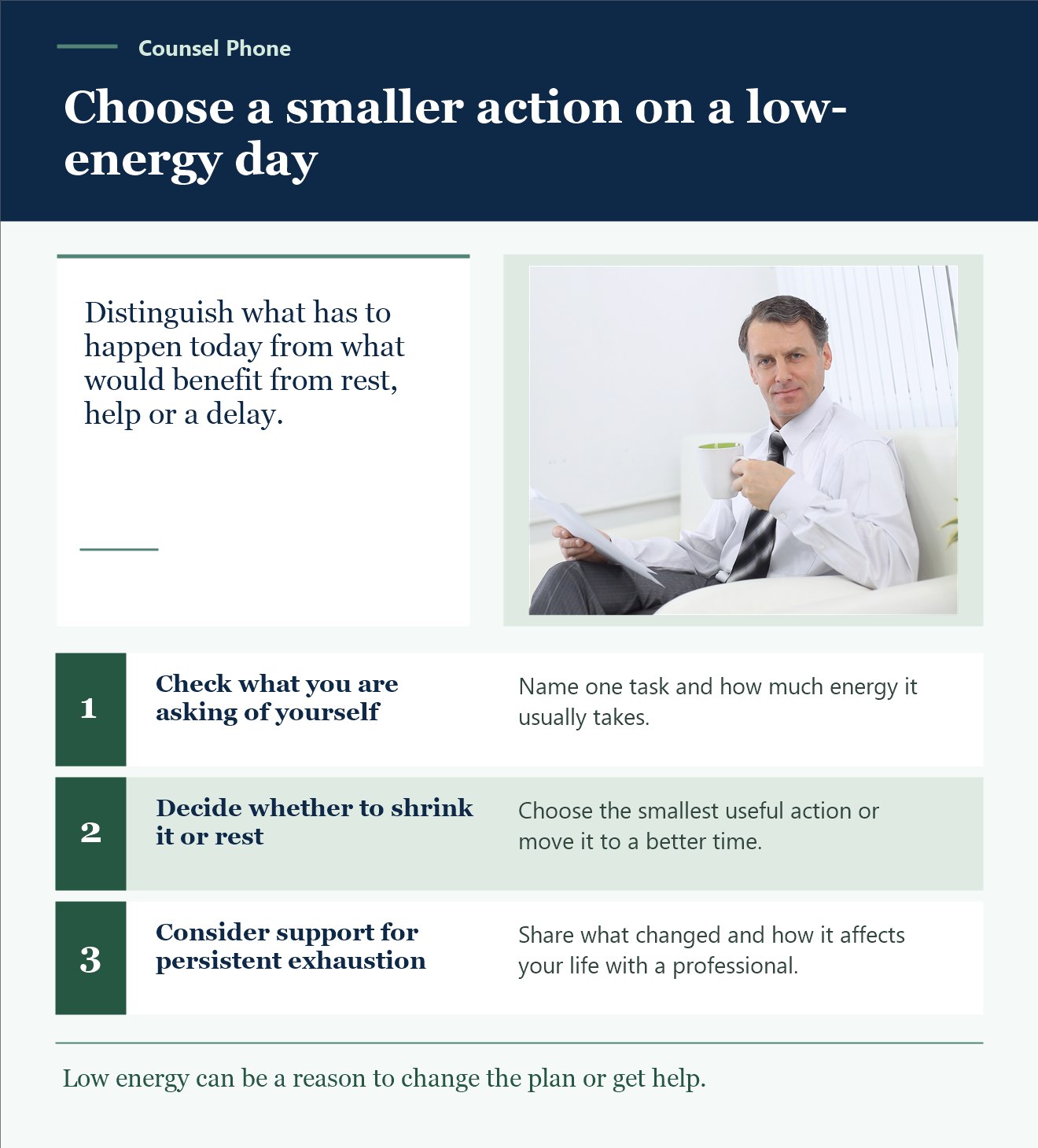
Choose a smaller action on a low-energy day
Distinguish what has to happen today from what would benefit from rest, help or a delay.
- Check what you are asking of yourself Name one task and how much energy it usually takes.
- Decide whether to shrink it or rest Choose the smallest useful action or move it to a better time.
- Consider support for persistent exhaustion Share what changed and how it affects your life with a professional.
Low energy can be a reason to change the plan or get help.