
Deciding if you should stay or leave the relationship can be a hard emotional choice. It normally isn’t a yes or no answer, but it comes from being pulled in different directions. Part of you wants to fix things, but part of you sees a possible better future.
This kind of conflict can be exhausting, and you might wonder if your feelings, your partner, or yourself can change. The truth is that these kinds of decisions don’t come lightly, and they shouldn’t. Taking time to understand what your situation is can prevent you from regretting your situation and help you to make grounded and confident choices.
Why Deciding This is So Hard
Relationships can be hard, but they can also be good. They share memories, emotional bonds, routines, and even families. Even when things aren’t working out great, there is still history, love, and hope.
Relationships are layered. They hold shared memories, emotional bonds, routines, and sometimes families and financial ties. Even when things aren’t working, there is often still love, history, and hope.
Push and Pull Effect
Push and pull effects can feel like:
- Hoping things can get better.
- Fear of losing what you have.
- Frustration with issues that keep repeating.
- Curiosity about what a new life could hold.
- Guilt about leaving.
These questions can cause emotional ambivalence, which is a time when you feel stuck between choosing to stay and choosing to leave.
Why Relationships Start to Fall Apart
Not every relationship ends for the same reason. Some problems are serious and hard to fix, while others are more common and can improve with time, effort, and awareness.
The Difference Between “Soft” and “Hard” Issues
A lot of people think relationships only end because of major problems like cheating or constant conflict. While those things do happen, they’re not always the main reason.
Some of the more common issues are actually quieter and build up over time.
Softer issues can include:
• Lack of communication.
• Ongoing arguments that never really get resolved.
• Feeling emotionally disconnected.
• Feeling alone even while in the relationship.
More serious issues can include:
• Abuse.
• Addiction.
• Infidelity.
What’s interesting is that many relationships don’t end because of one big moment, but they slowly drift apart because of those smaller, ongoing issues.
The Misunderstanding About Love
One of the biggest misunderstandings is believing that love should always feel strong, exciting, and effortless.
In reality, feelings naturally shift over time, and that’s completely normal.
What Usually Changes Over Time
• The excitement from the beginning starts to settle.
• Passion becomes less automatic.
• Effort slowly decreases without even realizing it.
This doesn’t mean something is wrong with the relationship. It usually just means it needs attention again.
When this shift is misunderstood, people can start to believe the relationship isn’t right anymore, when in reality, it just needs to be nurtured and reconnected.
The Blame Pattern
When a relationship is struggling, most people focus on what their partner is doing wrong, and even if this feels justified, it can stop important changes. This matters because if both partners are focused on blaming each other, neither of them is focusing on their own personal growth. This causes there to be a cycle where the problems keep repeating without there ever being a resolution. The best approach is to ask yourself:
- What role am I playing in this pattern?
- What can I do differently?
By changing your mindset, you can bring change even if your partner hasn’t changed yet.
Signs Your Relationship Might Be in Trouble
Even if your relationship is struggling, it doesn’t mean it has to come to an end. Some people can improve their relationships by putting in effort and using the right tools. Here are some signs your relationship might be in trouble:
-
Communication Turns into an Argument
If each conversation turns into an argument or you feel misunderstood, no matter how much you talk to your partner, then communication might feel impossible.
-
The Emotional Connection Isn’t There
If you feel distant, disconnected, or like you’re living a life separate from your partner, and the relationship feels more like it’s functional instead of emotional, then the emotional connection might not be there.
-
There’s No Trust
You or your partner may have broken trust suddenly, or it just changed over time through being disappointed repeatedly. All of these situations are serious issues, but there are changes that are possible if both partners are aware and put in the effort.
Should You Stay or Go?
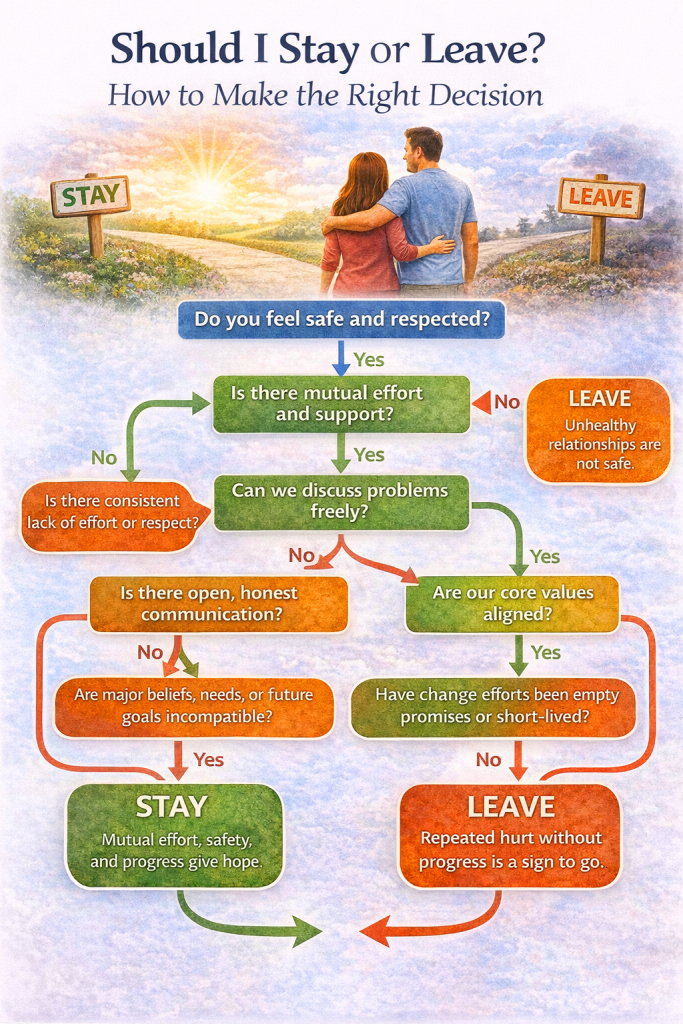
Some people find themselves thinking things like:
- Things might get better.
- I might be happier if I left.
- What if I regret staying?
- What if I stay too long?
These kinds of questions can be emotionally and mentally draining. You might feel like whatever decision you make isn’t completely the right answer, which makes it harder to move forward.
But when you feel overwhelmed, it can be tempting to make a fast decision just to get out of the discomfort.
Making the Decision to Leave
Research and real-life experiences show that there are some people who make a decision to leave but later question if their decision was wrong. Some people will realize that the issues that they were having could have been worked through if they had more understanding and the right support.
People aren’t always good at predicting what’s going to happen in the future, and what feels like an escape in a moment might not give you the outcome that you wanted.
Questions to Help You Decide
Instead of rushing to make a decision, take time to reflect deeply and ask these questions to get clarity:
- Am I in a temporary emotional crisis, or is this a long-term pattern?
- What are the best and worst outcomes if I stay?
- What are the best and worst outcomes if I leave?
- Have I communicated my needs clearly?
- Have I really listened to my partner’s perspective in this?
- What role am I playing in the relationship?
- Have we worked to improve the relationship?
- Would I regret not trying something else?
- Am I making a decision based on clarity or fear?
These questions aren’t about getting fast answers but about being honest and deep.
Why Staying Can Be Worth It
Staying might be worth it if:
- The issues are about behavior and not abuse.
- There is still respect, care, and emotional investment.
- Communication is still happening even when it’s hard.
- Both partners are willing to change and grow.
By putting in effort, some relationships can improve dramatically.
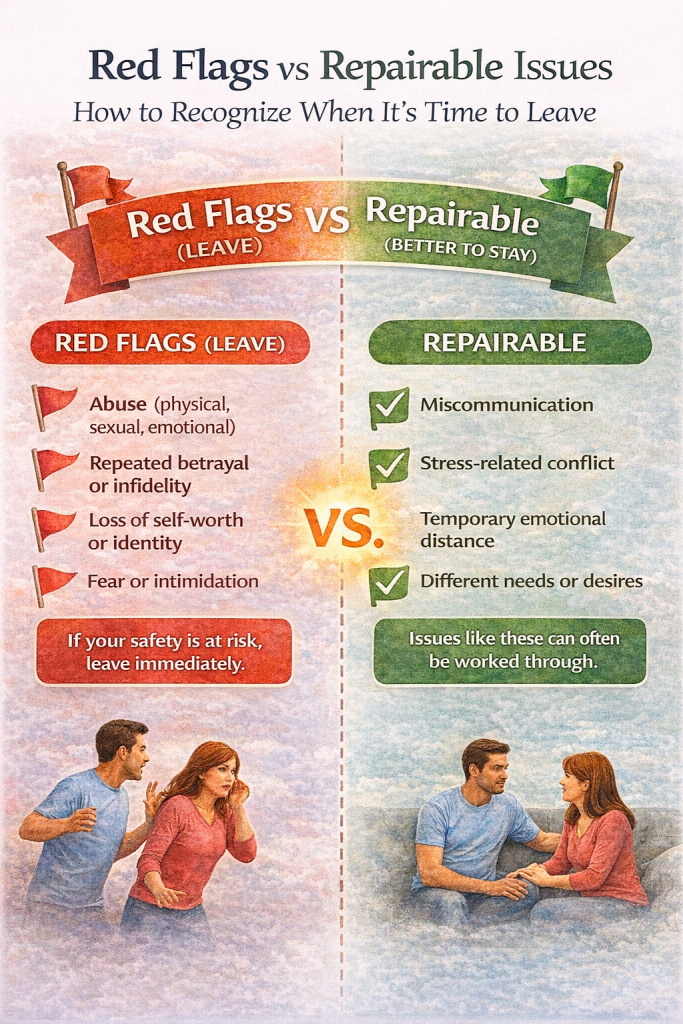
Leaving Might Be Necessary
Leaving might be necessary if:
- There is abuse or harm.
- Trust can’t be rebuilt.
- One or both of the partners refuse to change.
- The relationship damages your well-being.
When these things happen, putting your health and safety first is important.
Slowing Down
One thing that you can do is to slow down before you start making decisions. This helps because:
- It allows the emotions to settle down.
- It creates a place of reflection.
- It reduces the likelihood of making impulsive decisions.
- It gives you time to come up with solutions.
You don’t have to decide everything right away, and clarity sometimes comes by giving yourself time and a new perspective.
Getting Help and Support
You don’t have to figure out everything alone, and here are some helpful options to consider:
- Relationship coaching.
- Therapy.
- Couples counseling.
- Guided programs.
Even if your partner isn’t willing to participate in any kind of help, getting personal support can still help you to gain clarity.
Final Thoughts: Deciding to Stay or Go
Deciding to stay or go isn’t about finding the best or perfect answer, but it’s about making informed choices based on your own situation.
There are some relationships that can be fixed and can become stronger than they ever were before, but others have to end for you to find your own growth and well-being. What matters the most is that the decisions that you make are based on clarity and not pressure, impulse, or fear.
Take time to reflect honestly and trust that you’ll find the path that is right for your life.
Frequently Asked Questions
1. How do I know if I should stay or leave my relationship?
A good place to start is by looking at patterns instead of isolated moments. If there is still respect, emotional investment, communication, and mutual effort, the relationship may be worth working on. If there is abuse, repeated harm, or deep damage to your well-being, leaving may be the healthier choice.
2. Why is deciding whether to stay or leave so hard?
This decision is difficult because relationships usually contain both pain and hope at the same time. You may still love your partner, value your history together, and want things to improve, even while feeling unhappy or emotionally drained.
3. Can love still exist in a relationship that is no longer healthy?
Yes. Love can still be present even when a relationship is struggling. That is one reason people often feel torn, because love alone does not always solve repeated conflict, disconnection, or damage.
4. What are soft issues in a relationship?
Soft issues are problems that are often painful but may still be workable with effort and awareness. These can include poor communication, unresolved arguments, emotional distance, and feeling alone inside the relationship.
5. What are hard issues in a relationship?
Hard issues are more serious problems that can make a relationship unsafe or deeply unstable. These can include abuse, addiction, and infidelity, especially when there is no accountability or willingness to change.
6. Can a relationship end even without one major event?
Yes. Many relationships do not end because of one dramatic moment. They slowly weaken over time through repeated disconnection, unresolved problems, disappointment, and emotional distance.
7. Is it normal to feel confused about whether to stay or go?
Yes. Feeling torn is very common. Many people experience emotional ambivalence, where they can see both reasons to stay and reasons to leave, which can make the decision feel exhausting and unclear.
8. How can I tell if I am in a temporary crisis or a long-term pattern?
Ask yourself whether the issue feels recent and situational or whether it keeps repeating over time. A temporary crisis may improve with support and effort, while a long-term pattern often continues unless something meaningful changes.
9. What are some signs a relationship may still be worth saving?
A relationship may still be worth saving if there is still respect, care, emotional investment, and communication, even if things are hard. It also matters whether both people are willing to reflect, change, and grow.
10. When is leaving a relationship more likely to be necessary?
Leaving may be necessary when there is abuse, ongoing harm, trust that cannot be rebuilt, refusal to change, or a relationship that is consistently damaging your emotional or physical well-being.
11. Should I leave if trust has been broken?
Not always, but it depends on the situation. Some trust can be rebuilt when there is honesty, accountability, and real effort from both partners. If trust keeps breaking and repair never truly happens, leaving may be the healthier path.
12. Can communication problems be repaired?
Yes, communication problems can often improve when both partners are willing to listen, reflect, and respond differently. But if every conversation turns into conflict and neither person is open to change, the damage can deepen over time.
13. What role does self-reflection play in this decision?
Self-reflection is important because it helps you look at your own role in the relationship patterns instead of focusing only on your partner. This can bring more clarity, honesty, and emotional grounding to your decision.
14. Am I making the wrong choice if I feel fear either way?
No. Fear can exist in both directions. You may fear regret, loneliness, change, or staying too long. What matters most is whether your decision is rooted in clarity and truth rather than pressure, panic, or avoidance.
15. Should I make this decision quickly once I feel overwhelmed?
Usually no. Slowing down can help emotions settle, reduce impulsive choices, and create space for reflection. Many people gain better clarity when they stop rushing themselves toward an immediate answer.
16. What questions should I ask myself before deciding?
Helpful questions include whether this is a long-term pattern, whether you have clearly communicated your needs, whether you have listened to your partner, whether real effort has been made, and whether you are choosing from fear or clarity.
17. Can a relationship improve if only one person seeks help first?
Sometimes yes. Even if your partner does not want support, individual therapy, relationship coaching, or guided programs can still help you understand your situation more clearly and decide what to do next.
18. What if I am staying because of history, guilt, or fear of loss?
Those feelings are understandable, but they are not always enough to sustain a healthy relationship. Shared history and emotional attachment matter, but they should be weighed alongside respect, safety, trust, and real potential for change.
19. Does losing excitement mean the relationship is over?
No. Excitement and passion often change over time in long-term relationships. A quieter phase does not automatically mean the relationship is wrong, but it may mean the connection needs attention, effort, and reconnection.
20. What is the healthiest mindset when deciding to stay or leave?
The healthiest mindset is to seek an informed and grounded choice, not a perfect one. The goal is to make a decision based on honesty, reflection, and your well-being rather than guilt, fear, or emotional pressure.