

A long-term vision can be a rough direction you care about: steadier work, more time with people you love, a creative project or a home routine that feels more manageable. You do not need to discover one fixed purpose before making a useful choice.
Start with a change you would like to explore and what is possible in your life now. Money, health, caring responsibilities, discrimination and other people’s decisions can affect the options available. A plan should help you work with those conditions, rather than turn every obstacle into a personal failure.
On this page
1. Choose a direction that matters to you
Describe the part of life you want to improve in ordinary words. “I would like work with more predictable hours” gives you something to investigate. “I must become my best self” is harder to turn into a decision and can leave you feeling that nothing you do is enough.
Ask what the change would make possible. Predictable hours might mean collecting a child from school, attending an evening class or having a regular rest day. These details help distinguish your own priorities from an achievement that looks impressive to someone else.
You can have several priorities, and they may compete. A better-paid role might involve a longer journey; a course might take time away from another activity. Write down what you hope to gain and what you are willing to give up. You do not have to settle the trade-off immediately.
2. Look at resources and obstacles
Make two short lists: what you can use and what needs attention. Resources might include a skill, a helpful contact, a library, a small amount of time or information you already have. Obstacles might include cost, transport, inaccessible services or an unpredictable schedule.
Be specific about a barrier before deciding how to respond. If a qualification is too expensive, the next task may be checking funding or a different route. If you have no reliable childcare, adding another evening commitment may be unworkable at present. More determination does not solve every resource gap.
Separate an unknown from a decision. “I do not know what this role involves” calls for information. “I have checked the hours and they do not fit” may call for another option. Neither means you have failed to want the goal enough.
If spiritual reflection or a psychic conversation is personally meaningful, you can use it to explore questions about your values. Keep practical choices grounded in information you can check, including costs, conditions and the commitments involved. A prediction does not establish that a particular path will succeed.
3. Try a small planning experiment
Choose one action that gives you useful information without requiring a major commitment. You might read two job descriptions, ask about an accessible course, try one short practice session or speak with someone who can explain a process. Match the action to the time and energy you actually have.
For example, a person interested in changing careers could spend fifteen minutes listing the hours they need, then look at one suitable vacancy. They can compare the requirements with their existing experience before deciding whether training is necessary. That is progress in understanding the choice, even if they do not apply.
Give the task a stopping point. “Check the course fee and entry requirements on Saturday morning” is clearer than “sort out my future.” If Saturday becomes a difficult day, choose another time or reduce the task. A missed session is information about the plan, not a verdict on your character.
4. Review what happens
After trying the step, record what you learned. Was the activity interesting? Was the cost manageable? Did you need more help than expected? Notice both effort and conditions, rather than judging the result solely by how motivated you felt.
You might decide to repeat the experiment, ask another question or leave the idea alone. A review date can help you return to the choice without thinking about it constantly. Choose a useful interval for the task; there is no universal timetable.
Recognise small achievements in a way that suits you. You could save a completed note, tell a supportive person or enjoy a quiet break. Celebration is optional. You do not need to perform enthusiasm or pretend a difficult process has become easy.
5. Change the plan when you need to
A goal can stop fitting because your circumstances, interests or responsibilities change. Pausing, reducing or ending it can be a considered choice. Time already spent does not require you to keep investing in something that is no longer workable or worthwhile.
Before making a large change, look at any practical consequences: deadlines, shared responsibilities or commitments you need to discuss. You can keep a value while changing its form. Wanting to learn, for instance, might mean a free local activity now and formal study later.
If you feel stuck, ask for a specific kind of help: information about an application, company during a task or a conversation about the alternatives. You remain entitled to choose your direction. A useful plan makes the next decision clearer and leaves room for a life that cannot be fully predicted.
Read the infographic in text
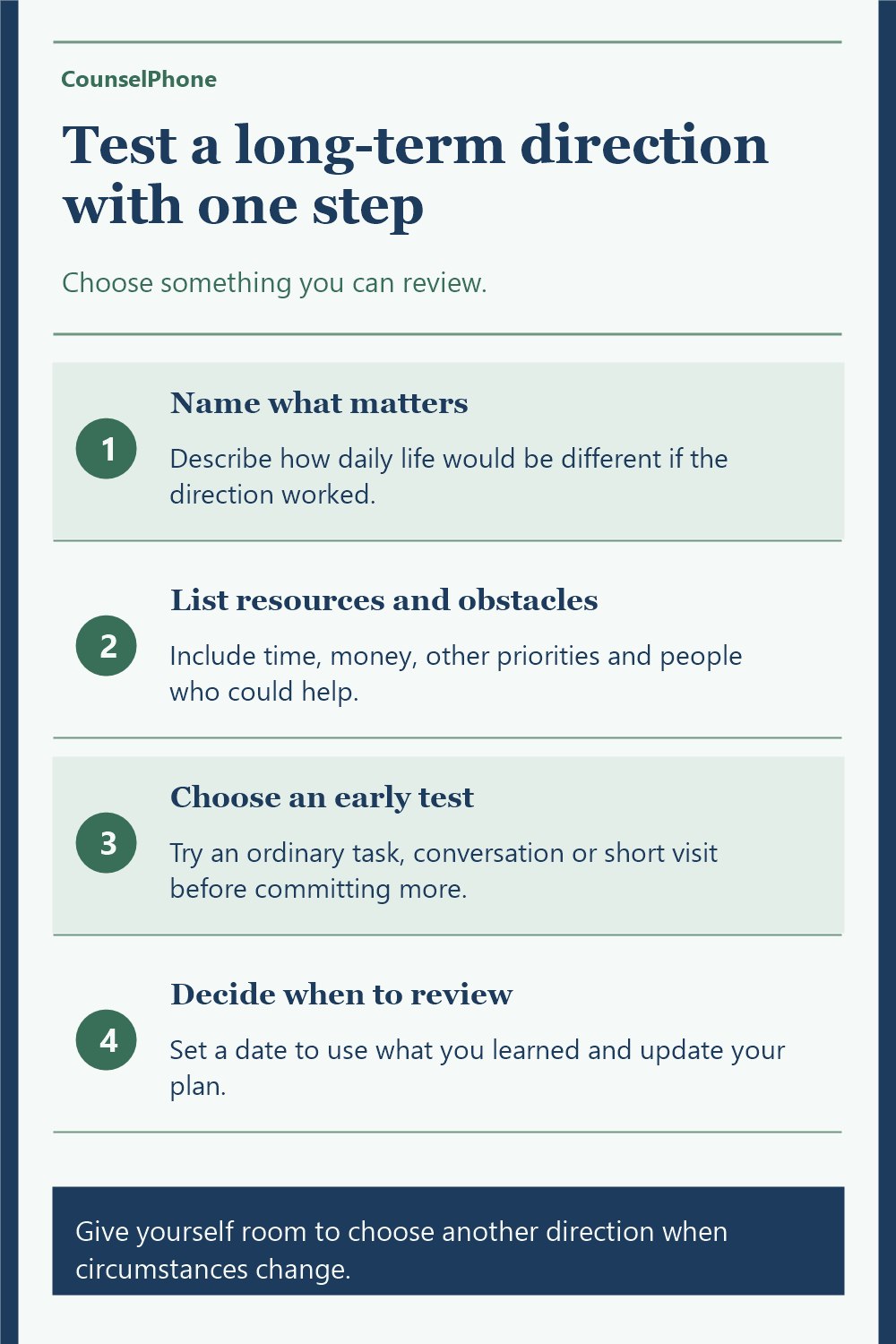
Test a long-term direction with one step Choose something you can review.
- Name what matters Describe how daily life would be different if the direction worked.
- List resources and obstacles Include time, money, other priorities and people who could help.
- Choose an early test Try an ordinary task, conversation or short visit before committing more.
- Decide when to review Set a date to use what you learned and update your plan.
Give yourself room to choose another direction when circumstances change.