

Thinking about a fuller life can help you name what matters: steadier work, time with people you love, a creative project or more room to rest. It becomes useful when you connect that wish with a workable decision. You do not have to believe you can achieve anything, ignore real limits or turn every goal into something bigger.
If you use the word abundance spiritually, you can keep that meaning while making practical plans. Your thoughts do not make you responsible for illness, discrimination, someone else’s choices or every opportunity you have missed. Start with what you want, what is available and what support could make a difference.
On this page
Name the life you actually want
Before asking how to have more, ask what more would allow you to do. A larger income might mean paying essential bills comfortably. A new qualification might mean changing your working hours. More confidence might mean asking a question at a meeting without rehearsing it all morning.
Write one sentence: “I want more room for ___ because ___.” Then describe an ordinary day in which that change is present. Include the unglamorous details: travel, childcare, energy, meals and time off. This can help you distinguish a goal you value from an impressive image you feel expected to pursue.
A quieter life, a reliable routine or keeping something good can be a worthwhile aim. Ambition does not have to mean constant expansion.
Separate assumptions from real constraints
Some obstacles are predictions you have not checked. Others are practical conditions that deserve attention. “Everyone will reject my application” differs from “The course clashes with my caring responsibilities.” Neither becomes easier by calling yourself negative.
- What do I know? List the current facts, including costs, deadlines and responsibilities.
- What am I assuming? Notice conclusions such as “It is too late for me” or “I must succeed immediately.”
- What can I find out? Ask about entry requirements, flexible hours, accessible options or an alternative route.
You can question an assumption without insisting on its opposite. “I do not know whether this will work; I can ask” is often more usable than “Nothing can stop me.”

Turn a broad goal into a small experiment
Choose one action that produces information without putting essentials at risk. If you want to write, try a short session twice this week. If you want different work, identify one role and compare its requirements with your experience. If you want more connection, suggest one specific, manageable plan.
Set three boundaries for the experiment: how much time you can give, what you can afford and when you will review it. For example: “I will spend twenty minutes finding free introductory classes on Thursday, then choose whether to attend one.” The experiment can end with a decision to continue, adjust or leave it.
Imagining a good outcome, praying or using an affirmation may be meaningful to you. Pair it with a next action and room for uncertainty; it cannot promise a job, another person’s agreement or a particular result.
Make room for support and trade-offs
A plan may need other people, resources or a different timetable. Ask for something concrete: feedback on an application, an hour of shared childcare or information about a local service. Someone declining does not establish that your goal is foolish, and encouragement alone cannot remove every barrier.
Consider what the plan would displace. A second project might reduce sleep or time with family. A paid course might compete with essential expenses. Keep commitments proportionate to your circumstances, and avoid treating a deadline or persuasive promise as a reason to make a rushed purchase.
Review progress without making it a verdict
At your review point, ask what you tried, what you learned and what now seems possible. Count useful information as well as completed tasks. Discovering that a route is unsuitable can prevent a larger commitment you would regret.
If the action was too demanding, make it smaller or seek help. If your priorities have changed, change the goal. A setback is information about this attempt, not proof that you thought incorrectly or failed to deserve a good life.
When you want to learn a skill on a tight budget
Suppose learning to sew would make it easier to repair clothes. Check whether a library lends a machine or offers a class, list the supplies you would need and set a price limit before signing up.
At the end of the month, assess what you learned and who you can ask for the next piece of help. Cost and access are constraints you can account for without blaming yourself.
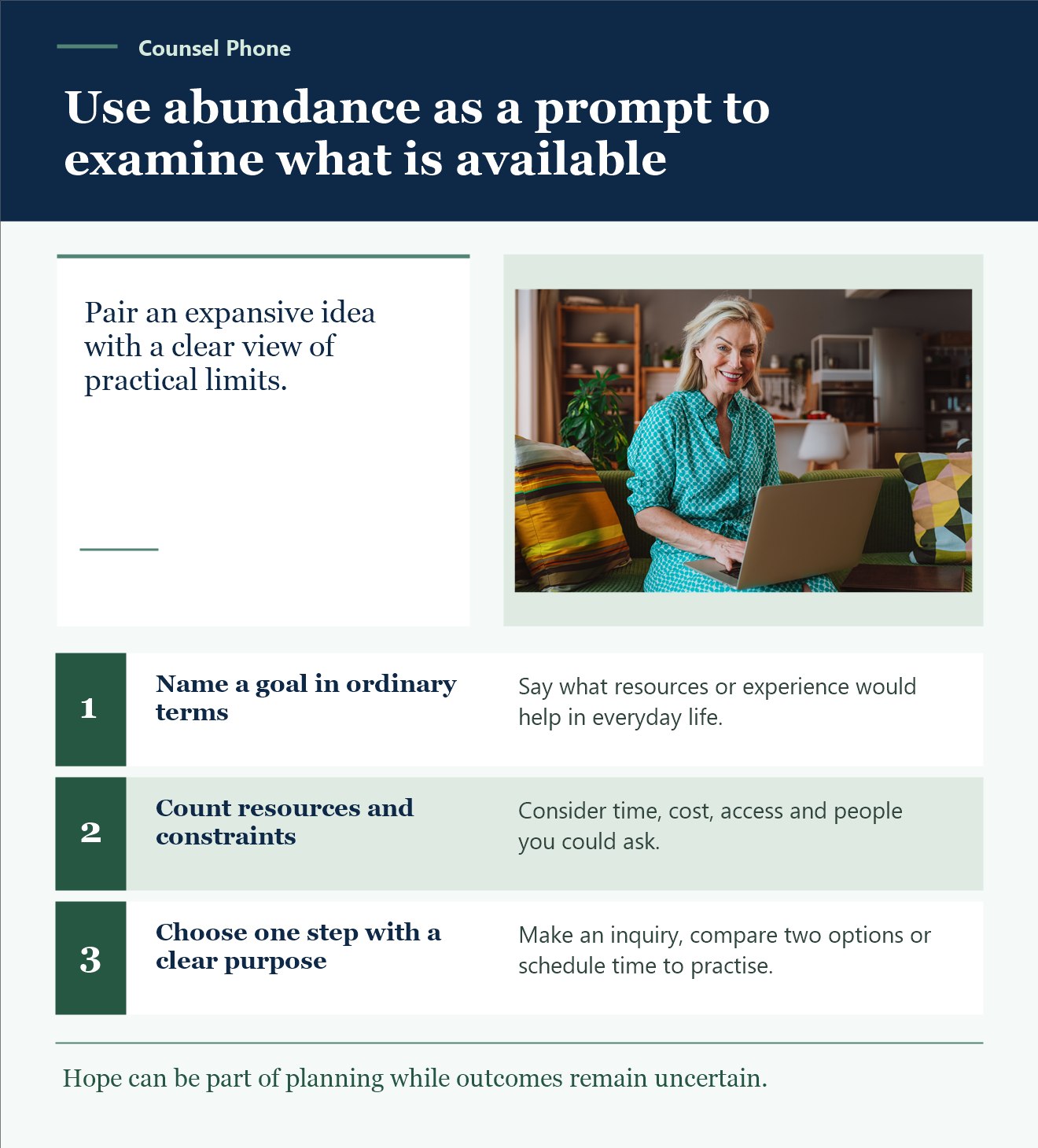
Read the infographic in text
Use abundance as a prompt to examine what is available
Pair an expansive idea with a clear view of practical limits.
- Name a goal in ordinary terms Say what resources or experience would help in everyday life.
- Count resources and constraints Consider time, cost, access and people you could ask.
- Choose one step with a clear purpose Make an inquiry, compare two options or schedule time to practise.
Hope can be part of planning while outcomes remain uncertain.